Our work
Shadowshot Systems
- Software Design & Development -
Shadowshot Systems

Branding

Software Design

Software Development

UX/UI

Video Creation
Developed by Kelowna Software Ltd., Shadowshot Systems is an augmented reality (AR) software platform that utilizes Microsoft HoloLens hardware by creating immersive models that provide the opportunity for people to walk through designs before they are constructed.
What It Is
Shadowshot Systems was created to help architects, engineers, designers, and project stakeholders visualize and validate designs earlier in the build process — before construction begins. Traditional tools like virtual reality were effective but slow, costly, and limited in collaboration potential. Shadowshot uses AR headsets (like Microsoft HoloLens) to place life-size 3D models directly into the real world, allowing users to walk through, inspect, and interact with designs together in a shared space.
The Problem It Solves
In large infrastructure and building projects (like bridges, hospitals, homes, etc.), design issues discovered late can be expensive and time-consuming to fix once construction starts. Shadowshot was built to make early design review faster, more affordable, and more flexible than traditional VR.
How It Works
• Augmented Reality Walkthroughs: Users wear untethered AR headsets to see 3D design elements overlaid on real spaces.
• Collaborative Experience: Multiple people can explore and discuss the project together in real time.
• Rapid Iteration: AR allows quicker model edits and lower costs compared to VR, making iteration practical for a broader range of projects.
Technical Platform
Shadowshot consists of a suite of tools:
• A design application where 3D CAD models are prepared for AR presentation.
• A control app on a tablet to navigate and manage the experience.
• A runtime component on the headset that synchronizes the experience for all participants.
The software is built with Unity 3D, C#, and Microsoft’s Mixed Reality Toolkit, and leverages Microsoft HoloLens hardware for immersive, shared AR interaction.
If you are interested in learning more about this software, check out our case study about it!
Case Study
The Project
Create an affordable solution that would allow users to rapidly test, adjust, and validate architectural drawings before they are built.
Billions of dollars are invested annually into designing and building projects to create new bridges, hospitals, communities, and other vital infrastructure.
Unfortunately, no matter how much planning and conceptualizing is done during the design phase of projects there are often unforeseen issues when projects enter the build phase.
Examples of design phase issues would be a staircase is in a poor location, taller workers hitting their heads on equipment built too low, or nurses charting stations being built where their ability to monitor patients is inhibited. Issues like these are problematic and typically very expensive and time-consuming to fix as they are often discovered during and after the build phase.
Catching design flaws earlier in the development process allows for reduced costs, improved functionality, increased satisfaction, and decreased time to completion.

The Problem
Costly and Labour Intensive
The prevailing solution being explored for this problem was through the use of Virtual Reality (VR) headsets. VR allowed for immersive experiences to bring design concepts to life prior to the construction phase, however, building VR models is a laborious and expensive process that does not allow for quick, rapid iteration.
Used as a ‘Gimmick’ to make Sales
Historically, this mean that VR headsets were a ‘gimmick’ used during the selling phase of a commercial property.
Limited Users & Use
Virtual Reality also has a number of draw backs – participants could only go one at a time, they were confined to a small space, and many users would get nauseated while in the virtual world.
The Goal
Kelowna Software wanted to know how to utilize technology to iterate quicker and make this a faster, more flexible, and cost-efficient process, to provide a solution to a wider range of projects including those with smaller budgets.
The Solution
Switch from VR to Augmented Reality (AR)
Kelowna Software determined that in order to improve the design phase of projects and create fast, flexible, effective models they needed to develop an augmented reality (AR) solution.
AR Allows for More Choices for Less Cost
Compared to VR, AR is less detailed, allows for increased flexibility, faster edits, and lowered cost, yet still provides the opportunity for interactive walkthrough experiences that allow for improved building design validation.
Multiple Participants at the Same Time
It also allowed Kelowna Software to create a shared world, where multiple participants could wear headsets and talk about the project together, simultaneously.
Test in the Real World at the Actual Location of the Build Site
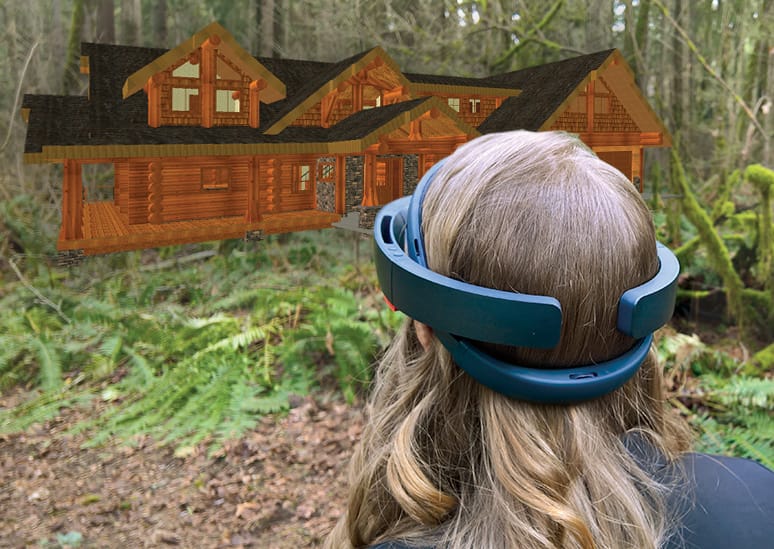
Since AR headsets aren’t tethered to a computer, participants were free to walk around, and the technology could even go onto a build site where clients could see the final project as it would look in the real world.
Improve the Experience For All
Lastly, users did not experience the same nauseating effects in AR as they did in VR, making more users open to and willing to utilize the technology.
The Result
Developed Shadowshot Systems Software
Kelowna Software developed Shadowshot Systems. Shadowshot is a custom software that utilizes Microsoft HoloLens hardware and creates immersive models that provide the opportunity for people to walk through designs. The software allowed for modelling that could be developed 30-50x faster than VR, at 2% of the cost, also allowing for rapid iteration of the design.
Tested Real Architectural Drawings
In order to validate Shadowshot, Kelowna Software worked with McElhanney (a company that provides surveying, engineering, GIS & remote sensing, community planning, landscape architecture, and environmental services) to test their software. McElhanney used Shadowshot to create a mixed-reality experience of a bridge that was being built in India, and were able to have multiple people experience and test their designs prior to construction.
Implemented with Pioneer Log Homes, From the Timber Kings HGTV Show
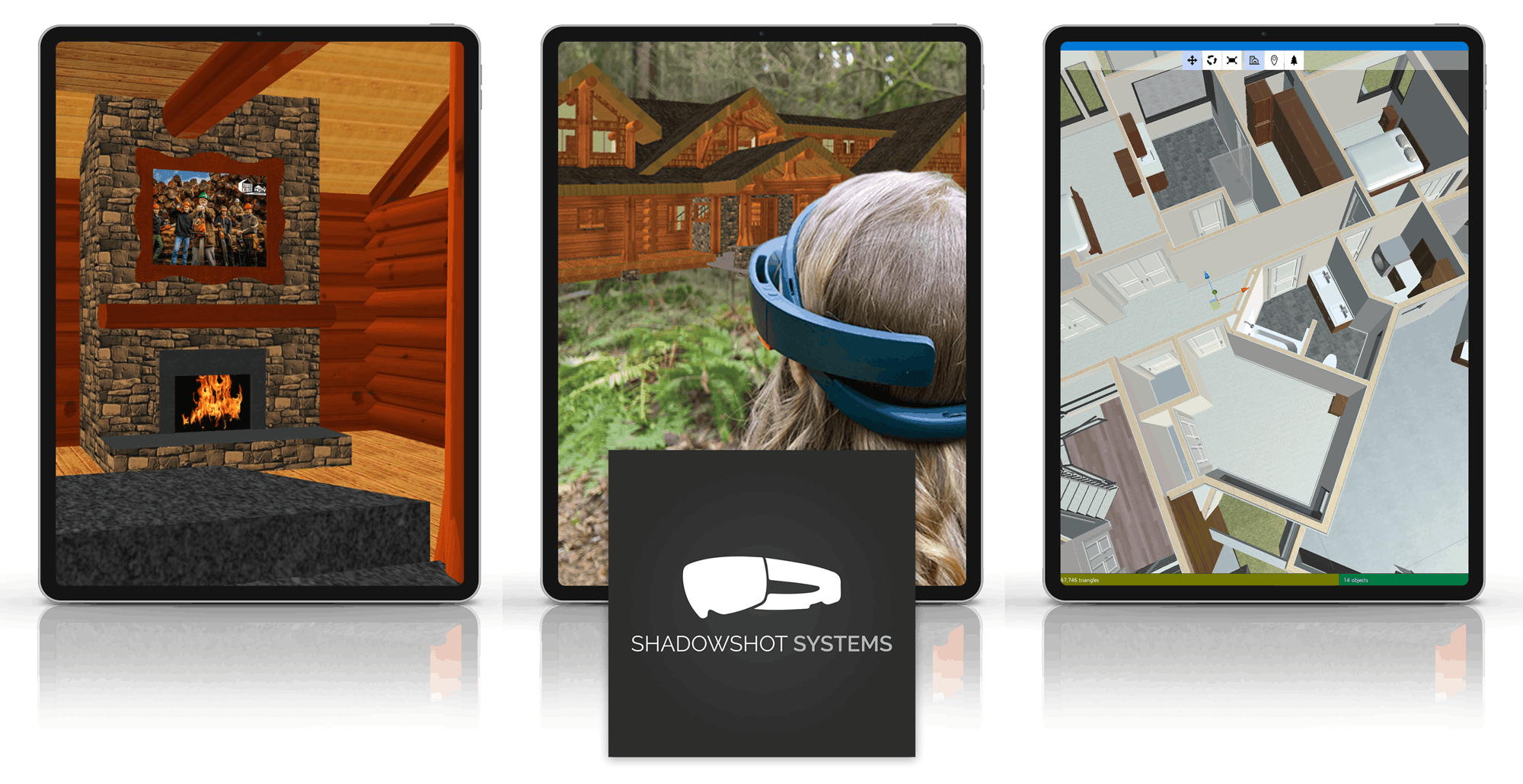
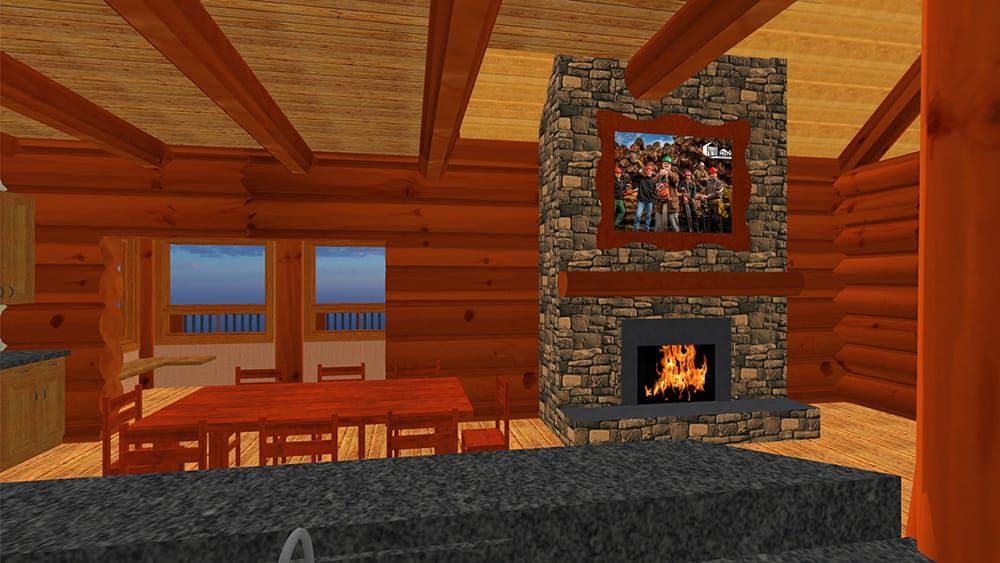
Pioneer Log Homes of the Timber Kings TV show on HGTV was one of the first businesses to utilize Shadowshot technology. The solution allowed their customers and prospective customers to physically walk through custom log homes during the design phase increasing confidence and satisfaction in their designs.
The Approach (The Technical Stuff)
Shadowshot Systems consisted of 3 separate software products. A design tool, a control app and a runtime engine.
Design Tool
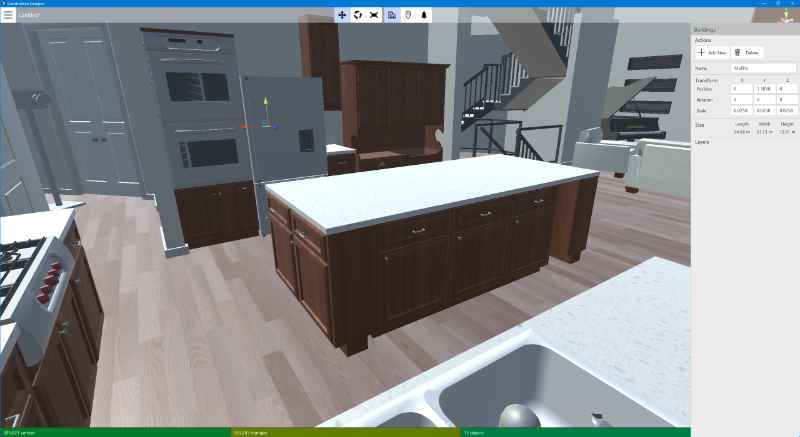
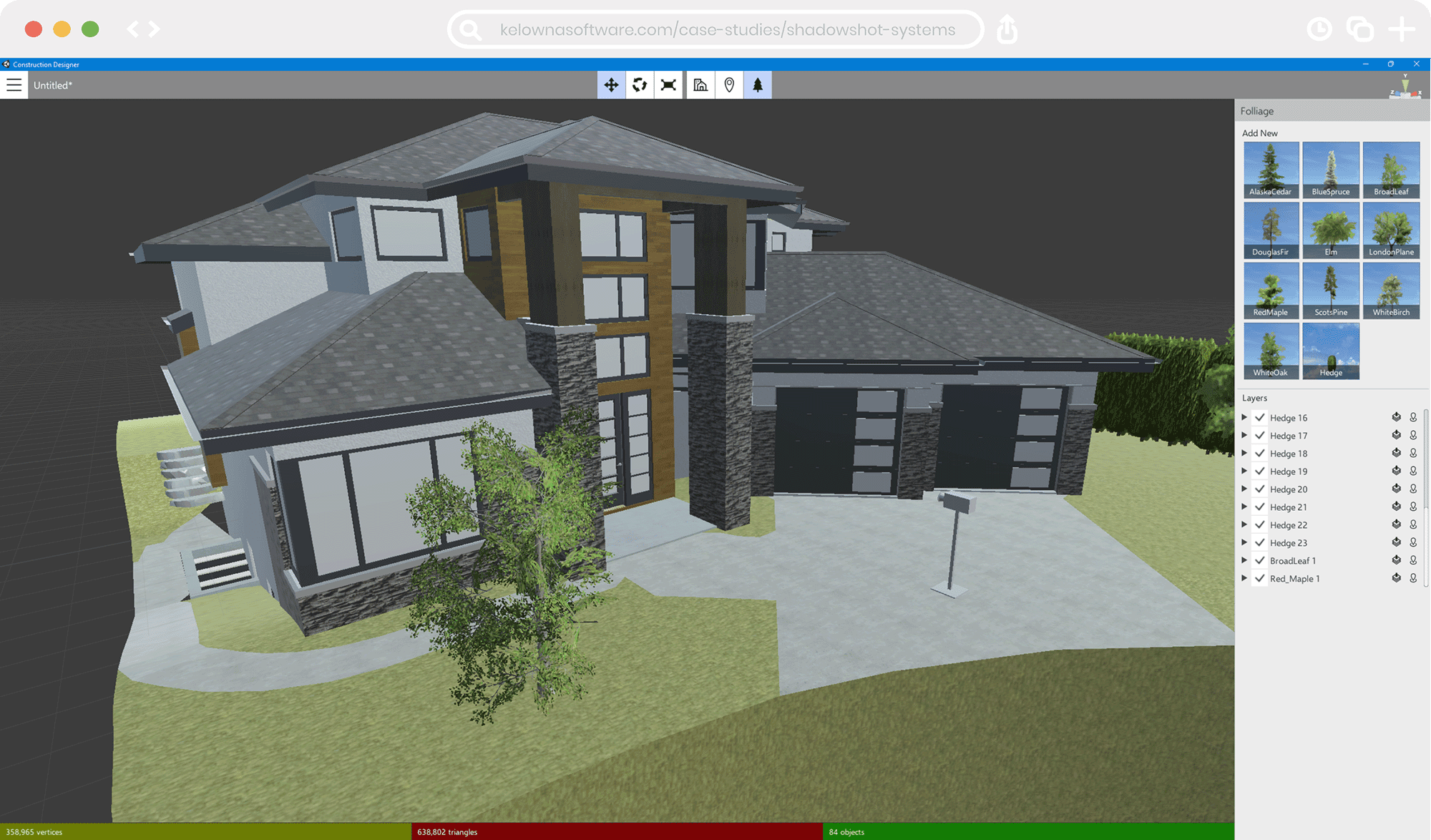
The design tool is where users could import their 3D CAD models into the 3D engine and scale, rotate, place jump-to positions, and even add things like hedges, trees and fences. The model was then persisted in a local database where it could be loaded by the AR headsets. The software was written using Unity 3D engine and C#, with an API and back end using Microsoft ASP.NET Core and Microsoft SQL Server. 3rd party tools included SpeedTree, Polygon and Autodesk VRED.
Control App
The second software application was a control app that managed all the rooms, opening of files, moving around within a scene and user height adjustments. This software is meant to be run on a tablet and held by the presenter to control all aspects of the presentation. This software was written using Unity 3D engine and C#, and 3rd party libraries including the Mixed Reality Toolkit.
Software That Connects It All Together
The third software application was the software that ran on the AR headset and communicated with the control app to keep all the users in the session synchronized together. Each participant saw the 3D model anchored in the same spot in the real world with surprising accuracy. This software was built using Unity 3D and C#, with 3rd party libraries including the Mixed Reality Toolkit.